

· Views 528
The McGinley Dynamic indicator is an understated tool that many are unaware of, offering an innovative approach to minimising lag in moving averages and reacting to fast-moving financial markets. In this article, we will explore how this indicator works, how to set it up, and what signals it produces. #OPINIONLEADER#
Understanding the McGinley Indicator
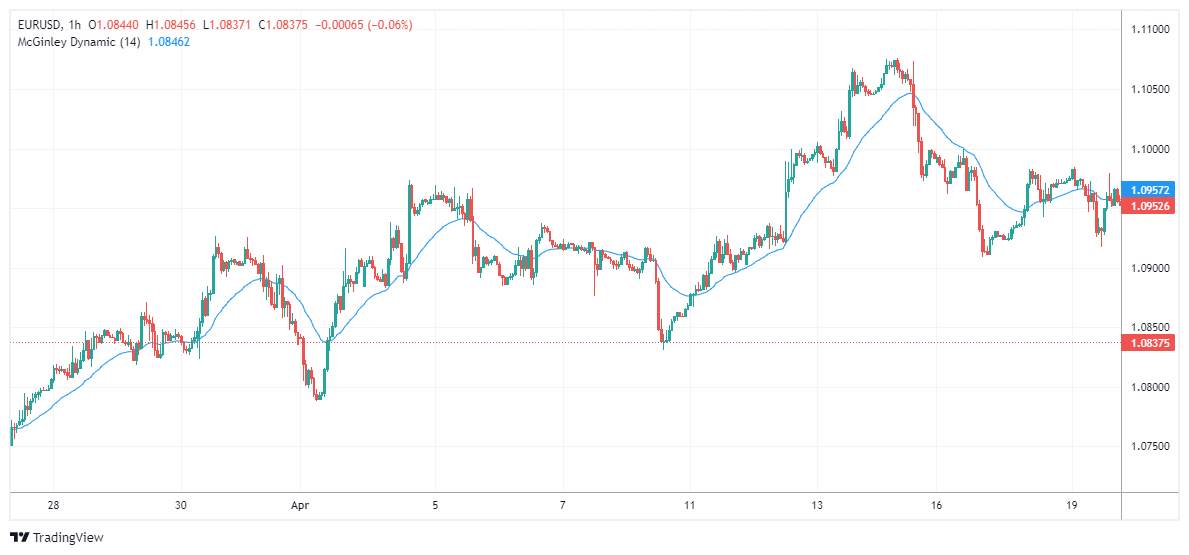
Introduced by John R. McGinley in 1990, the McGinley Dynamic indicator is a unique tool designed to solve a common problem in the world of trading - the “lag” associated with moving averages. The most popular moving averages, like the simple moving average (SMA), exponential moving average (EMA), and weighted moving average (WMA), aren’t able to adapt to fast-moving markets, meaning they lag behind the latest price movements and often produce false signals.
The McGinley Dynamic is a type of moving average that can adjust itself according to the speed of the markets. When speed picks up (represented by increased volatility), it closely follows price action without significant separation between price and its line. The indicator slows down in calmer markets and generally avoids the whipsaws commonly seen in other moving averages.
At its core, the McGinley Dynamic indicator is just another way to smooth out price action and gauge the potential direction of the market. But its ability to adapt and adjust itself sets it apart from other moving averages and allows traders to gain a much more accurate understanding of market dynamics. This is why many in the know call it “the most reliable indicator you have never heard of.”
McGinley Dynamic Formula and Calculation
The calculation of the McGinley Dynamic Indicator may seem a bit complex at first glance, but it’s based on a simple principle: adapting quickly to changes in the market.
It’s calculated using the following formula:
In this formula:
In simple terms, this formula calculates the difference between the current price and the previous McGinley Dynamic value. It then divides this difference by a value that changes depending on the ratio of the current price to the previous McGinley Dynamic value. This result is then added to the last value to arrive at the current value.
The crucial part of this formula is the (Price/MD1)^4 component. This factor is what allows the McGinley Dynamic Indicator to adjust itself to the speed of the market. When the price moves quickly, this factor increases, causing the indicator to react more rapidly. The opposite is true for slow-moving price action.
Understanding the McGinley Indicator
Introduced by John R. McGinley in 1990, the McGinley Dynamic indicator is a unique tool designed to solve a common problem in the world of trading - the “lag” associated with moving averages. The most popular moving averages, like the simple moving average (SMA), exponential moving average (EMA), and weighted moving average (WMA), aren’t able to adapt to fast-moving markets, meaning they lag behind the latest price movements and often produce false signals.
The McGinley Dynamic is a type of moving average that can adjust itself according to the speed of the markets. When speed picks up (represented by increased volatility), it closely follows price action without significant separation between price and its line. The indicator slows down in calmer markets and generally avoids the whipsaws commonly seen in other moving averages.
At its core, the McGinley Dynamic indicator is just another way to smooth out price action and gauge the potential direction of the market. But its ability to adapt and adjust itself sets it apart from other moving averages and allows traders to gain a much more accurate understanding of market dynamics. This is why many in the know call it “the most reliable indicator you have never heard of.”
McGinley Dynamic Formula and Calculation
The calculation of the McGinley Dynamic Indicator may seem a bit complex at first glance, but it’s based on a simple principle: adapting quickly to changes in the market.
It’s calculated using the following formula:
MD = MD1 + (Price - MD1) / (N * (Price/MD1)^4)
In this formula:
- MD is the McGinley Dynamic value that we're aiming to calculate.
- MD1 is the previous period's McGinley Dynamic value.
- Price is the current period's price.
- N is a constant factor, usually set to a value similar to that of a moving average period (for instance, 10, 14, or 20).
In simple terms, this formula calculates the difference between the current price and the previous McGinley Dynamic value. It then divides this difference by a value that changes depending on the ratio of the current price to the previous McGinley Dynamic value. This result is then added to the last value to arrive at the current value.
The crucial part of this formula is the (Price/MD1)^4 component. This factor is what allows the McGinley Dynamic Indicator to adjust itself to the speed of the market. When the price moves quickly, this factor increases, causing the indicator to react more rapidly. The opposite is true for slow-moving price action.
Tuyên bố miễn trừ trách nhiệm: Quan điểm được trình bày hoàn toàn là của tác giả và không đại diện cho quan điểm chính thức của Followme. Followme không chịu trách nhiệm về tính chính xác, đầy đủ hoặc độ tin cậy của thông tin được cung cấp và không chịu trách nhiệm cho bất kỳ hành động nào được thực hiện dựa trên nội dung, trừ khi được nêu rõ bằng văn bản.
Bạn thích bài viết này? Hãy thể hiện sự cảm kích của bạn bằng cách gửi tiền boa cho tác giả.

Để lại tin nhắn của bạn ngay bây giờ