

The approval of the first spot Bitcoin ETFs on January 10, 2024, marked a turning point, with cryptocurrency pivoting towards major institutional adoption and global financial regulations to prompt nation-state adoption and legitimize Bitcoin with traditional finance. In 2025, Bitcoin is no longer just a digital currency; it is now a socio-economic force with major world powers like the United States moving to use it as a strategic reserve asset.
Bitcoin has achieved mainstream financial acceptance, peaking at an all-time high of $126,210.50, but it remains highly volatile. The asset has lost about 28% of its value in recent times, prompting economists, investors, and enthusiasts alike to ask:
- Why is Bitcoin valuable?
- Is Bitcoin safe?
- Will Bitcoin crash or go up long-term?
Why Bitcoin Is Valuable: The Fundamental Explanation
Bitcoin is not a traditional financial asset, and as such, stakeholders ask questions like “Why is Bitcoin worth so much?” and “Why is Bitcoin actually valuable?” Scarcity, decentralization, security, and network effects are significant factors driving Bitcoin’s intrinsic value.
Its market value rises through controlled supply as a hedge against inflation, just like the controlled mining of the gold asset. Through its blockchain technology, Bitcoin operates a decentralized system with no central financial administrator. This trustless system allows anyone to create a new Bitcoin address and transact on the blockchain without any central approval.
The security of the BTC network, which employs public-key cryptography to secure its transactions, is also driving its value. As such, each user can generate a unique address for transactions. Also, Bitcoin boasts the highest hash rate with miners distributed around the world.
Consequently, major financial institutions, government bodies, and companies have begun integrating BTC into their financial systems in the form of payments and asset reserves. Goldman Sachs, MicroStrategy, Tesla, and Fidelity are already integrating Bitcoin ETFs, trading desks, and treasury reserve assets into their services.
With investors using Bitcoin as a major reserve hedge against inflation, the question of ‘why is Bitcoin valuable?’ is now answered. More so, due to the excessive money creation between 2020 and 2025 to combat the economic slump brought about by COVID-19, fiat currencies dipped in value, while assets like gold began skyrocketing in value as a major economic reserve.
In 2025, fiat currencies are losing their financial strength against emerging reserve assets like Bitcoin and Gold, which hit all-time highs in October. Economists now view Bitcoin’s impact on financial systems as a significant catalyst to drive its value even higher, with major Bitcoin prediction analysis projecting a price as high as $250,000 by 2030.
Bitcoin’s Impact on Financial Systems (Key Structural Shifts)
Bitcoin’s impact on the world’s financial system is not gainsaying; it is already in motion. Banks are integrating BTC custody for customers, thereby drawing institutional investors to adopt the asset. Notable among such developments was the U.S. bank resuming its BTC custody services to institutional investors through an early access program.
Major payment networks like Visa and Mastercard have enabled crypto rails with BTC payments as a frontier. The rise of Bitcoin ETFs has also increased professional investing, as investment managers now prioritize crypto investments alongside fiat ones.
Through the growing adoption of the Lightning Network, a layer-2 solution that drives fast and low-cost transactions, cross-border payments are now seamless and cheaper than before. Due to the growing influence of Bitcoin, 11 countries have launched a CBDC, with many others conducting extensive studies on CBDCs to maintain financial stability and improve inclusion.
Bitcoin’s Social Impact: From Financial Freedom to Digital Identity
Bitcoin has steadily grown from an asset for financial freedom to a globally recognized digital identity. Under inflationary governments like Turkey and Argentina, for example, Bitcoin has been integrated as a major hedge against inflation and a recognized digital identity. Argentina now has a crypto turnover of about $94 billion, while Turkey reached $200 billion in crypto transactions for 2024.
By helping unbanked populations access financial tools through crypto, Bitcoin is now a major store of value for content creators, remote workers, startups, and many others, thereby pioneering a cultural movement of self-custody, sovereignty over one’s assets, and decentralization for ease of transaction.
Is Bitcoin Safe? Understanding the Risks and the Reality
Bitcoin’s network is safe to a great extent as its blockchain infrastructure incorporates cryptographic technology to mitigate network hacks, amidst other security measures like decentralization and a 99.9% uptime. However, investor safety is not quite as pronounced due to price volatility, phishing attacks, exchange downtime, and crypto trading scams.
Also, its regulatory safety is still making its way up, as there is no universal legal compliance for Bitcoin. Despite global frameworks to support anti-money laundering (AML) regulations in the U.S., EU, and Asian regions being in motion, a universal standard has yet to be achieved.
Beginner traders and investors can reduce the risk of scams and wallet compromise by using offline hardware wallets, reputable exchanges like Binance and Bybit, zero leverage, and secure seed phrase storage.
Will Bitcoin Crash Again? A Look at Market Cycles
A look at its market cycles suggests that a crash is imminent, but a recovery is inevitable. In 2013, it peaked at $1,100 but subsequently crashed by 85%. In 2017, it peaked at $20,000 but then crashed by 84%. 2021 saw a peak of $69,000 and a crash of about 77%. Now in 2025, it has peaked at $126,000, with a crash within the range of 77% to 85% imminent, due to previous price action.
An outlook towards 2026 now suggests that with the ETF market gaining ground, and major institutional adoptions happening with a lower speculative leverage, a crash will occur, but a recovery to an upper price point is inevitable. So, a wise trading action will be to take profit at price highs before the higher highs are reached.
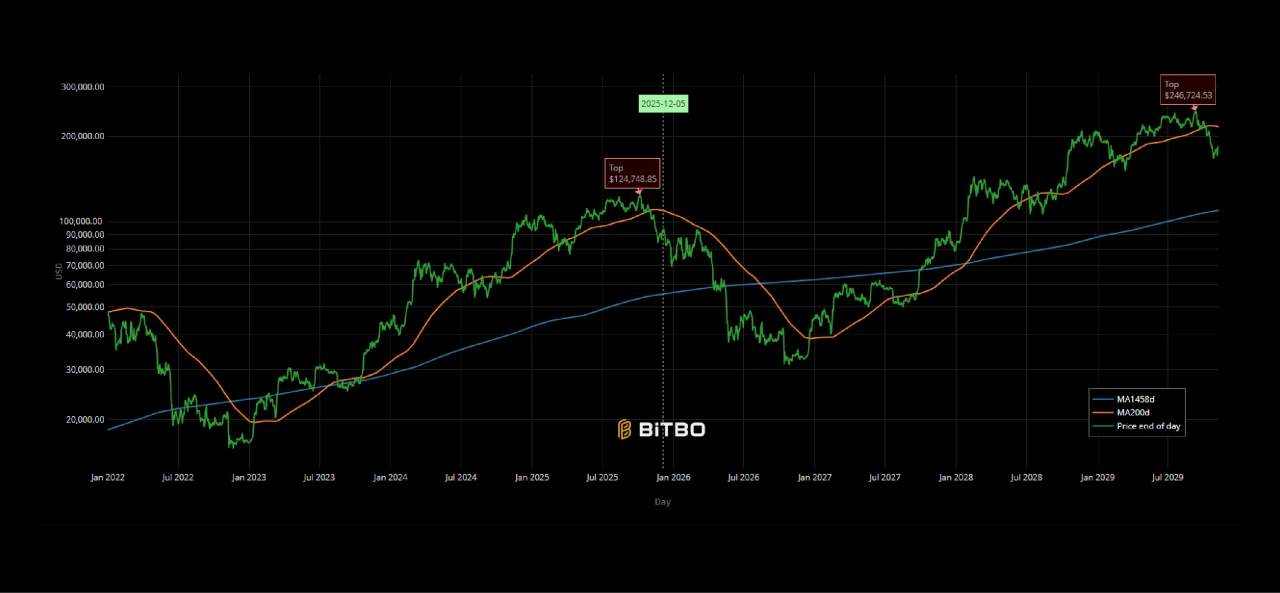 Source: BiTBO
Will Bitcoin Go Up? Factors Driving Future Value
It is more likely for Bitcoin to go up than the reverse due to significant price drivers like the growing adoption of crypto ETFs and institutional support, the layer-2 lightning network solution that makes BTC more usable for cross-border payments, the 2028 Bitcoin halving which will further reduce the supply, the global macro environment of inflation cycles and interest rates, nation-state adoption models which are moving towards BTC as a major asset reserve, and the technological advancements in the blockchain towards a cheaper, seamless, and secure ecosystem.
Is Bitcoin A Good Investment? The Real Answer
Bitcoin has proven its credibility as a solid long-term investment, particularly over its four-year cycles. The question ‘is Bitcoin a good investment?’ is answered by the staggering investment returns delivered by tracing the cycle lows to peaks.
Bitcoin typically undergoes around 75% to 85% price corrections during each 4-year cycle, as evident from the price action between 2013 and 2017 and 2021 and 2025. Moreover, Bitcoin’s asymmetrical upside, which has enabled investors to achieve maximum ROI at cycle peaks, makes it a suitable investment for long-term investors, conservative investors, high-risk takers, and beginner investors alike.
While BTC acts as a hedge against fiat debasement, risks such as volatility, price drawdown, and crypto regulations exist. But if you can stomach the sharp price corrections, a maximum ROI is more likely over a long period of investment.
Limitations and Concerns: What Critics Point Out
Despite Bitcoin’s transformative impact on the world’s financial system, critics still point out limitations such as price volatility, environmental issues from mining activities, non-diversification of mining locations, nation-level regulatory actions, and short-term price spikes driven by ecosystem hype as inhibiting factors to stamping Bitcoin as a globally recognized financial reserve and legal tender. However, emerging blockchain advancements show that these concerns might not be necessary as Bitcoin’s impact is projected towards a socio-economic revolution.
Conclusion— Bitcoin’s Impact Is No Longer Just Financial
Through Bitcoin’s next-level blockchain technology, financial transactions can now be trustless, seamless, and more secure. By reshaping the scenery of traditional finance and empowering individuals financially through the advent of cryptocurrencies, Bitcoin has influenced global markets and is pioneering a global socio-economic revolution. Bitcoin’s long-term development depends on adoption, ecosystem regulation, and its long-term price cycles; however, its impact on society and financial systems is undeniable. #Bitcoin##BTC/USD##USDollar#
Đã chỉnh sửa 08 Dec 2025, 18:13
Tuyên bố miễn trừ trách nhiệm: Quan điểm được trình bày hoàn toàn là của tác giả và không đại diện cho quan điểm chính thức của Followme. Followme không chịu trách nhiệm về tính chính xác, đầy đủ hoặc độ tin cậy của thông tin được cung cấp và không chịu trách nhiệm cho bất kỳ hành động nào được thực hiện dựa trên nội dung, trừ khi được nêu rõ bằng văn bản.

Để lại tin nhắn của bạn ngay bây giờ