

 The Quick Pump That Wasn’t
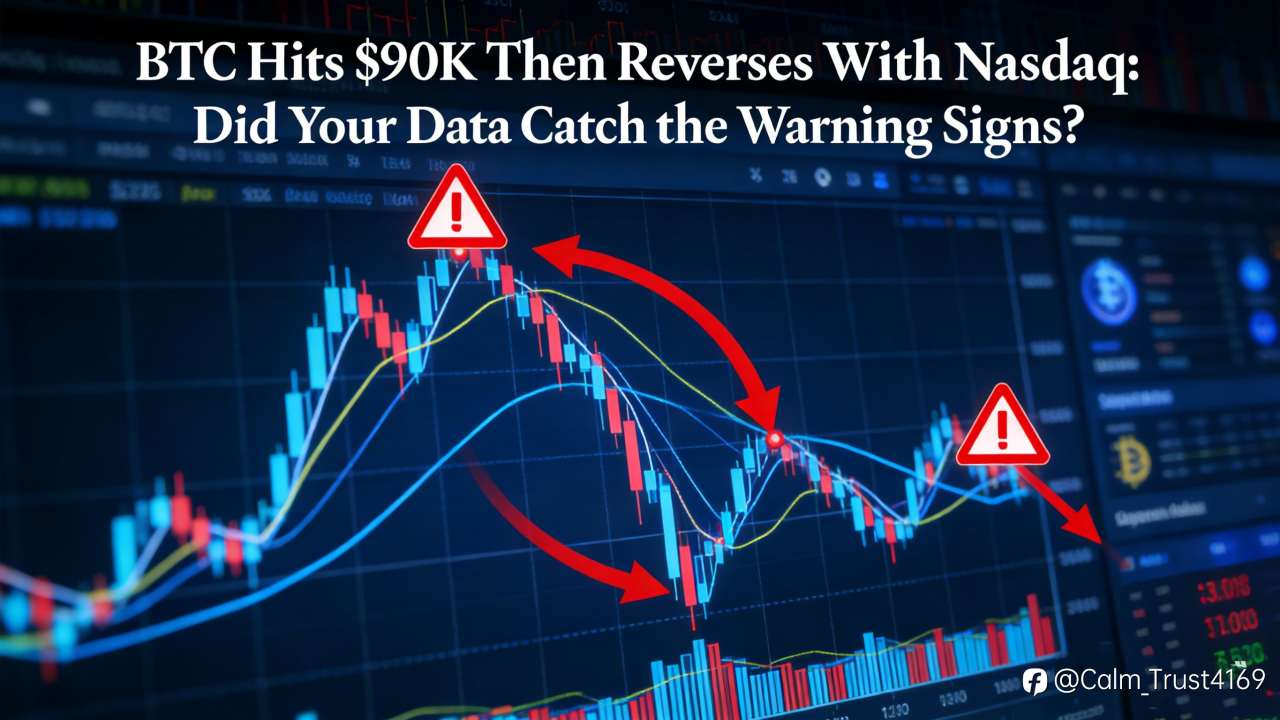
Have you ever watched bitcoin spike toward 90,000 dollars, felt the rush of momentum, only to see it evaporate minutes later as Nasdaq futures wilted? Early Asian trading on Monday saw BTC climb above 90,000 dollars for the first time in weeks, dragging altcoins like XRP toward 1.85$, ETH near 2,940$, SOL to 123$, and even DOGE edging up to 0.123$, with the CoinDesk 20 Index surging before retreating. But the rally fizzled fast — BTC dipped below 88,000$, mirroring Nasdaq 100 futures down 0.5% as Wall Street’s tech bellwether foreshadowed a rocky open.
This wasn’t isolated noise. It was crypto moving in lockstep with risk assets, amplifying a broader rotation where tech weakness pulled high-beta plays like BTC back into line. The real question for traders: did your setup see the Nasdaq correlation building before BTC reversed, or only after the candle closed red?
Nasdaq Futures as Crypto’s Shadow Price
The tape told the story in real time. Bitcoin’s brief push above 90,000$ sparked optimism across the space, but as Nasdaq futures softened on inflation data, Fed rate cut expectations, and year-end rebalancing, crypto felt the ripple immediately. Market makers at Wintermute have noted for months that this positive correlation strengthens during Nasdaq downturns — risk rotates out of high-volatility assets like BTC into safer havens, creating sharp reversals that look like “fakeouts” on single-asset charts.
Zoom out and Layer-1 tokens broadly underperformed in 2025 despite network progress, with total value locked rising but prices decoupling from fundamentals. Ethereum still dominates revenue splits, Solana gained ground, and institutional mechanics like custody and staking drove adoption, but the daily grind was defined by these Nasdaq-tied rotations rather than pure crypto narratives. When tech futures wilt, BTC takes the hit first — making cross-market visibility not just helpful, but essential for avoiding traps like Monday’s aborted rally.
Why Single-Asset Charts Hide the Real Risk
Most traders experienced this as frustration: BTC looks strong, alts follow, then everything pulls back without warning. The problem isn’t bad timing; it’s incomplete data. Retail setups show BTC candles in one app, Nasdaq futures in another, and perhaps a quick glance at tech ETFs if you’re lucky. By the time you mentally connect “Nasdaq down 0.5% = BTC reversal,” the low-risk entry is gone, and you’re chasing a move that’s already half over.
The edge lives in microstructure across assets: watching BTC ticks alongside Nasdaq futures depth, seeing when SOL or XRP volume picks up before BTC accelerates (or stalls), and measuring how quickly reversals propagate from tech weakness into crypto. If your data lives in silos, you’re trading stories pieced together after the fact. If it’s unified and tick-level, you see Nasdaq stress hit BTC order books seconds before price confirms the turn.
Alltick: Crypto + Equities + FX on One Synchronized Tape
Alltick turns this fragmented view into a single, coherent feed. Through low-latency HTTP endpoints and WebSocket streams, it delivers tick-level prices and order book data across cryptocurrencies, U.S. and Hong Kong equities, indices like Nasdaq futures proxies, forex, and commodities — all under one consistent schema. That means the same interface tracking BTCUSDT and ETHUSDT also streams Nasdaq-linked ETFs, tech sector indices, and FX pairs reacting to rate expectations, aligned tick-by-tick on a shared timeline.
With Alltick, Monday’s session becomes replayable truth: you see Nasdaq futures depth thinning as BTC approaches 90,000 dollars, watch XRP and SOL volume lead or lag, and measure exactly how crypto’s high-beta nature amplified the rotation out of tech. Backtests built on this data capture Nasdaq-crypto correlations at full resolution, not smoothed bars that hide the propagation speed. Live dashboards show warnings forming across assets, letting you tighten risk or flip bias before the candle closes.
No more guessing whether a BTC spike is “real” or Nasdaq-tied. You measure it. Test it before the next futures open. Grab a free Alltick account, connect BTC, ETH, SOL, XRP, a Nasdaq proxy ETF, and one tech-heavy index — then stream ticks during the next U.S. session. Replay any reversal like Monday’s and compare: did your old charts show the equity stress building into crypto, or only the BTC print after it was too late?
If Alltick reveals rotations, lead-lag signals, or risk cascades your current setup buried, upgrade your data today. When Nasdaq pulls BTC back again or finally lets it run, you’ll trade the tape, not its echo.
Tuyên bố miễn trừ trách nhiệm: Quan điểm được trình bày hoàn toàn là của tác giả và không đại diện cho quan điểm chính thức của Followme. Followme không chịu trách nhiệm về tính chính xác, đầy đủ hoặc độ tin cậy của thông tin được cung cấp và không chịu trách nhiệm cho bất kỳ hành động nào được thực hiện dựa trên nội dung, trừ khi được nêu rõ bằng văn bản.

Để lại tin nhắn của bạn ngay bây giờ