

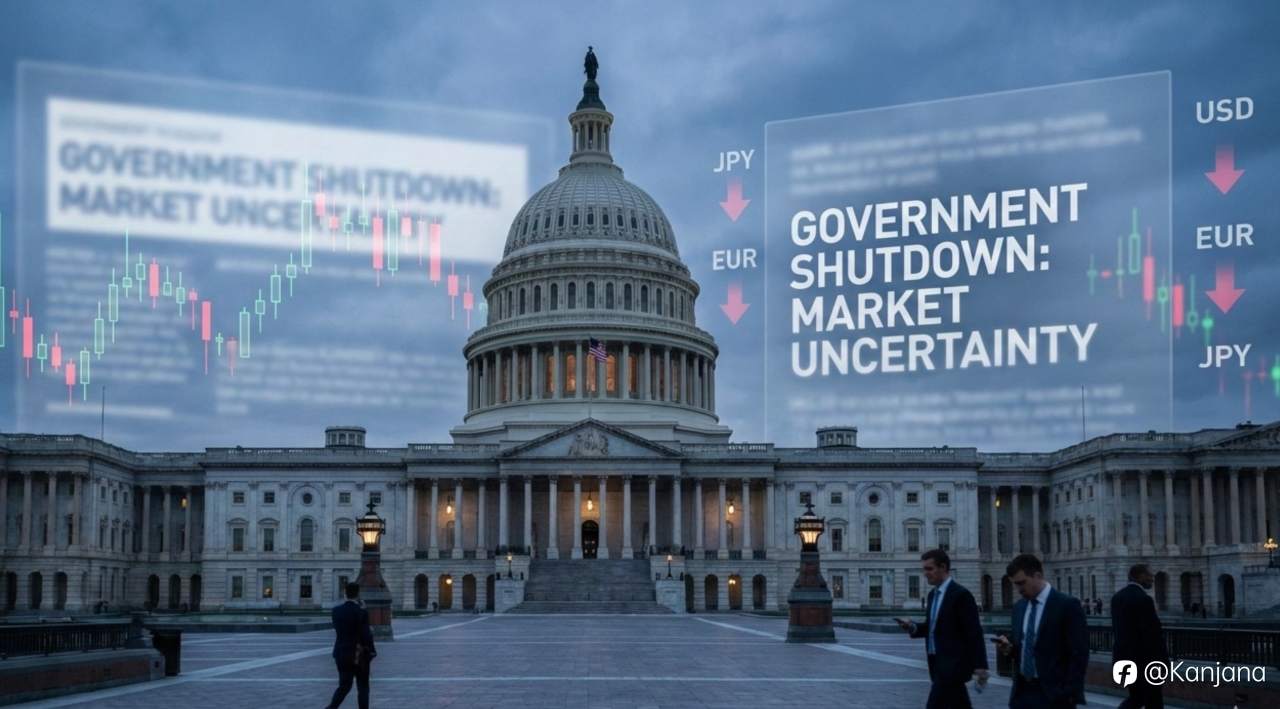
The ongoing government shutdown has once again become a key source of uncertainty for global financial markets. While shutdowns are not new to investors, the timing and broader macro backdrop make the current situation particularly sensitive. Markets are already navigating elevated interest rates, slowing growth signals, and heightened geopolitical risks adding fiscal paralysis into the mix only amplifies volatility.
At its core, a government shutdown reflects political gridlock rather than an immediate economic collapse. However, markets do not price events in isolation; they price confidence, continuity, and risk perception. When those factors weaken, capital tends to reposition quickly.
Why the Current Shutdown Matters More Than Usual
In normal conditions, markets often treat shutdowns as temporary disruptions. This time, however, investors are paying closer attention due to several overlapping concerns:
- Fragile confidence: With growth expectations already under pressure, any disruption to fiscal operations can accelerate risk off behavior.
- Policy uncertainty: Delays in budget approvals, government spending, and economic data releases reduce transparency for investors and policymakers.
- Headline sensitivity: Markets are reacting more to political signals and negotiation outcomes than to traditional economic indicators.
As a result, price action across asset classes has become increasingly headline driven, with sharp intraday reversals and reduced conviction in longer term positioning.
Market Behavior in a Shutdown Environment
Historically, government shutdowns tend to create a defensive market tone rather than outright panic. Typical patterns include:
- Rotation into safe haven assets such as gold and short duration government bonds.
- Higher volatility in FX markets, especially for USD pairs, as confidence rather than fundamentals drives short term pricing.
- Reduced risk appetite in equities and risk sensitive currencies, particularly during prolonged negotiations.
Importantly, the impact intensifies the longer the shutdown persists. Short shutdowns are often faded by the market; extended ones tend to erode confidence more meaningfully.
Implications for the U.S. Dollar and FX Markets
The U.S. dollar’s reaction during a shutdown is rarely one dimensional. While USD is traditionally viewed as a safe haven, shutdown related uncertainty can weaken its appeal in the short term especially if investors interpret political deadlock as a governance risk.
Key FX observations in the current environment:
- USD moves are increasingly driven by confidence and sentiment, not just rate expectations.
- Dollar weakness may emerge against major currencies during risk recalibration phases.
- USD rebounds, when they occur, are often technical and short lived unless supported by constructive headlines.
For traders, this reinforces the importance of scenario based planning rather than directional bias.
Trading and Investment Considerations
In a shutdown driven market regime, discipline becomes more important than conviction. Some practical principles include:
- Avoid chasing moves driven purely by headlines.
- Expect false breakouts and stop loss sweeps, particularly during low liquidity sessions.
- Focus on key technical zones and wait for confirmation rather than reacting emotionally to news.
- Adjust position sizing to account for elevated volatility.
This is not an environment that rewards aggressive positioning. Instead, it favors patience, flexibility, and strong risk management.
Broader Economic Perspective
While a government shutdown can temporarily disrupt services and data flow, its long term economic impact depends on duration and resolution quality. A swift political compromise tends to limit damage, while prolonged stalemates increase the risk of delayed growth, weakened business confidence, and tighter financial conditions.
Markets are forward looking. What matters most is not the shutdown itself, but how quickly and credibly it is resolved.
The current government shutdown has reinforced a defensive tone across global markets. Rather than reacting to traditional economic data, investors are pricing political risk, confidence erosion, and policy uncertainty. Volatility is likely to remain elevated, with markets staying highly sensitive to headlines and negotiation outcomes.
In this environment, the most effective approach whether trading or investing is to remain disciplined, manage risk proactively, and avoid overreacting to short term noise.
Tuyên bố miễn trừ trách nhiệm: Quan điểm được trình bày hoàn toàn là của tác giả và không đại diện cho quan điểm chính thức của Followme. Followme không chịu trách nhiệm về tính chính xác, đầy đủ hoặc độ tin cậy của thông tin được cung cấp và không chịu trách nhiệm cho bất kỳ hành động nào được thực hiện dựa trên nội dung, trừ khi được nêu rõ bằng văn bản.


-KẾT THÚC-