

Recent headlines once again remind markets that geopolitics and policy risk can resurface suddenly and reprice expectations fast.
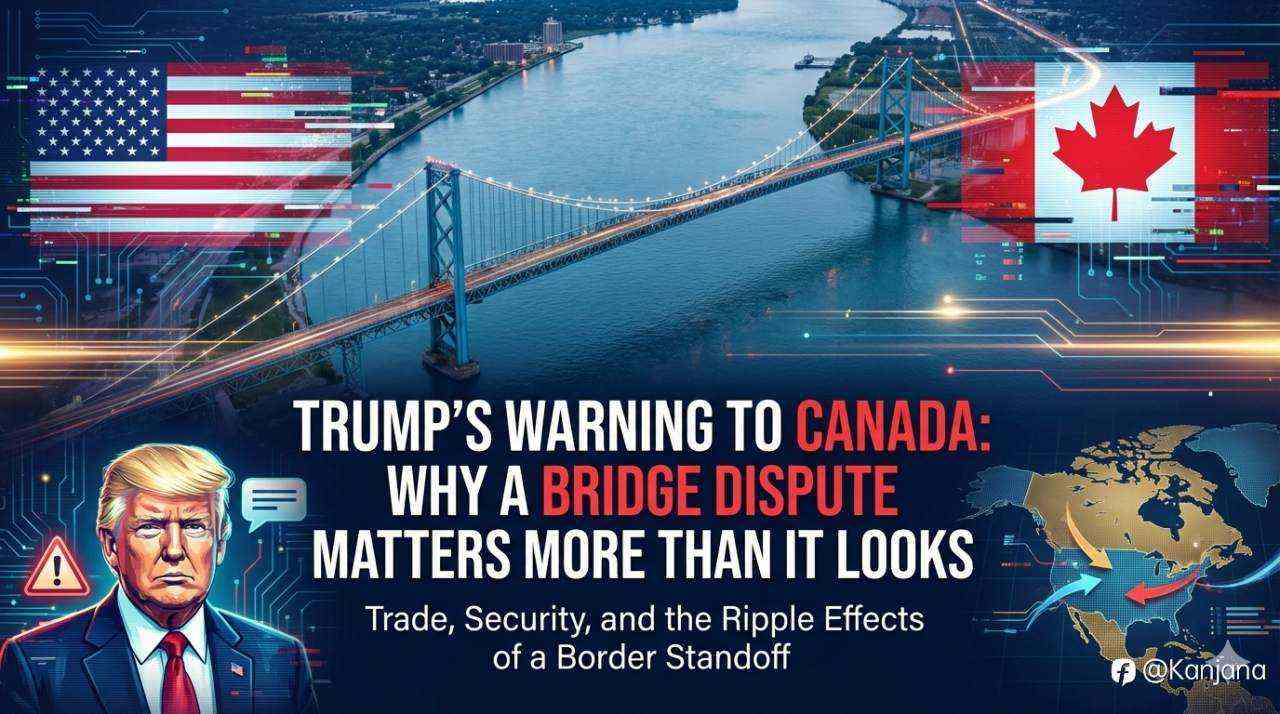
Former U.S. President Donald Trump has threatened Canada over the new Ontario Michigan bridge project, publicly demanding a 50% U.S. ownership stake. While the dispute may appear narrow at first glance, focused on a single cross border infrastructure project, the broader implications reach well beyond a bridge.
At its core, this is not only an infrastructure issue it is a signal of how trade leverage, political bargaining, and cross border economic relationships could be reshaped under renewed protectionist rhetoric.
Why This Matters Beyond Infrastructure
The Ontario Michigan corridor is one of the most critical trade routes between the U.S. and Canada, supporting billions of dollars in goods flow annually. Any uncertainty surrounding ownership, access, or political interference raises several red flags for markets:
- Supply chain risk: Even verbal threats can introduce uncertainty for logistics, manufacturing, and trade dependent sectors.
- Policy unpredictability: Markets dislike ambiguity. Demands framed as political leverage increase perceived policy risk premiums.
- Cross border relations: U.S. Canada relations are often seen as stable; disruptions challenge that assumption.
For investors and traders, this is a reminder that headline risk can return abruptly, even in areas traditionally viewed as low risk.
Market Perspective: Why Traders Should Pay Attention
From a macro and FX standpoint, these developments reinforce a familiar pattern:
Markets are not always driven by data alone. Political statements especially those hinting at trade friction can influence:
- Risk sentiment: Heightened uncertainty often pushes capital toward defensive positioning.
- Currency behavior: Trade sensitive currencies can experience volatility spikes, even without immediate policy action.
- Short term volatility: Headline driven markets are prone to sharp intraday reversals.
Importantly, this type of rhetoric does not need to materialize into concrete policy to affect markets. The expectation of conflict is often enough.
A Familiar Playbook, A Relevant Reminder
This episode fits into a broader historical pattern:
Infrastructure, tariffs, and trade routes frequently become negotiation tools during periods of political escalation. Markets have seen this before and they tend to react quickly, even if outcomes are delayed or diluted.
For traders, the key takeaway is not to overreact to a single headline, but also not to ignore it.
Trading Takeaway: Stay Flexible, Not Emotional
In environments like this, discipline matters more than conviction:
- Avoid chasing moves sparked purely by headlines
- Trade around key levels, not political narratives
- Expect higher volatility and faster sentiment shifts
- Keep risk size adjusted to uncertainty, not confidence
When geopolitics enters the conversation, probabilities matter more than predictions.
Conclusion
Trump’s comments on the Ontario Michigan bridge may sound like political noise, but markets have learned sometimes the hard way that policy language can evolve into real economic consequences.
For now, this story serves as a timely reminder:
Headline risk is never truly gone. It simply waits for the right moment to return.
Disclaimer: This article is for informational purposes only and does not constitute investment advice. Financial markets involve significant risk. Always conduct your own analysis and manage risk responsibly.
Đã chỉnh sửa 10 Feb 2026, 08:38
Tuyên bố miễn trừ trách nhiệm: Quan điểm được trình bày hoàn toàn là của tác giả và không đại diện cho quan điểm chính thức của Followme. Followme không chịu trách nhiệm về tính chính xác, đầy đủ hoặc độ tin cậy của thông tin được cung cấp và không chịu trách nhiệm cho bất kỳ hành động nào được thực hiện dựa trên nội dung, trừ khi được nêu rõ bằng văn bản.


-KẾT THÚC-