

Why Most Traders Get Trapped?

avatar
Đã xác minh Chính thức
· Views 11,136

Many traders already understand charts and are familiar with technical indicators. Yet strangely, they still frequently get “trapped” by the market. Looking back, the issue often isn’t technical analysis, it’s something commonly overlooked: forex market sentiment. The market is not just a collection of numbers and lines. Behind every candlestick lies human emotion: fear, greed, panic, and euphoria. When you begin to understand the market’s “mood,” you don’t just see where price is going, you understand why it is moving.
In this article, we’ll explore what forex market sentiment is, how to read it, and how to apply it practically in daily trading. The objective is simple: to help you trade with context: calmer, more patient, and more rational, instead of merely reacting to price movements.

What Is Forex Market Sentiment?

Market sentiment represents the overall attitude or emotional bias of the majority of market participants toward a particular currency or currency pair.
Sentiment is typically categorized as:
  • Bullish sentiment → market optimism; most traders tend to buy
  • Bearish sentiment → market pessimism; most traders tend to sell
Forex market sentiment reflects collective psychology, not just one individual’s analysis. Although it may seem abstract, sentiment can be measured objectively using various tools and positioning data.

Why Is Market Sentiment Important in Forex?

The forex market does not move purely on logic. Prices often shift due to:
  • Market expectations
  • Reactions to news
  • Changes in market narrative (risk-on vs. risk-off)
  • Collective emotions
When the majority of traders share the same view, their combined actions can:
  • Form trends
  • Accelerate volatility
  • Trigger sudden reversals
Understanding market sentiment helps traders:
  • Avoid entering when the market is overcrowded
  • Identify potential reversals
  • Avoid being trapped on the wrong side of the market

What Is a Sentiment Index in Forex?

A Sentiment Index is a tool that measures the ratio of long and short positions among traders, either in real-time or periodically. A well-known example is the SWFX Sentiment Index by Dukascopy. This index is based on transaction flow and displays long vs. short ratios for:
  • Popular currencies
  • Major currency pairs
  • Consolidated data from various market participants
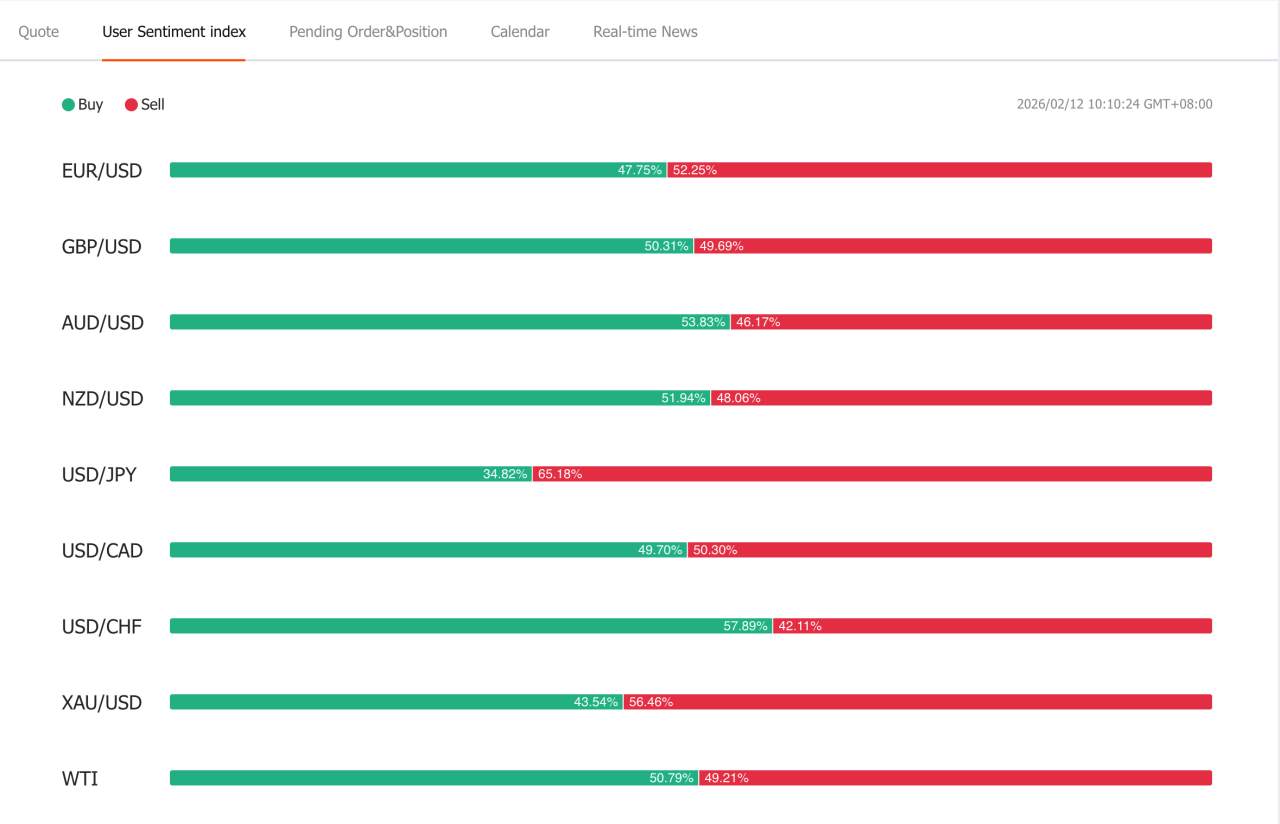
Additionally, the Followme platform provides a comprehensive User Sentiment Index, allowing traders to check their preferred pairs (such as EUR/USD, XAU/USD, etc.) to see whether the market leans toward buying or selling.

Who Is Included in Sentiment Data?

Liquidity Consumers

This group includes:
  • Retail traders
  • Brokers
  • Investment companies
  • Hedge funds
Their sentiment ratio shows the percentage of long or short positions relative to total open trades.

Liquidity Providers

This group includes:
  • Major banks
  • Centralized marketplaces
Their data often moves opposite to liquidity consumers, since every OTC transaction involves opposing positions.
Sentiment Index data is typically updated every 10–30 minutes, making it relevant for intraday trading.

How to Read Forex Market Sentiment

A sentiment index displays the percentage difference between long and short positions. Example:
  • 60% of traders are long, 40% are short → Sentiment Index = +20% (bullish)
  • Positive value → buy-side dominance
  • Negative value → sell-side dominance
However, sentiment does not always predict the next price move accurately.

Sentiment as a Contrarian Indicator

Many professional traders use market sentiment as a contrarian signal.
The logic is simple:
  • If almost all traders are positioned on one side
  • The market may already be overcrowded
  • The probability of reversal increases
Example:
If EUR/USD sentiment is extremely bullish and most traders are long, price may be at risk of turning lower.
This aligns with statistics showing that 70–80% of retail traders tend to lose money, meaning their positioning often conflicts with the medium-term market direction.

How to Use Forex Market Sentiment in Trading

Sentiment should not be used alone, it works best as a complementary filter.

Confirm Technical Signals

Example: "Your strategy generates a BUY signal, but sentiment shows extreme overbought conditions → consider delaying entry."

Avoid Overcrowded Zones

Extreme sentiment often signals:
  • Stop hunts
  • False breakouts
  • Potential reversals

Combine with Technical Indicators

Sentiment can confirm or invalidate signals from:
  • Moving average crossovers
  • MACD divergence
  • Structural breakouts

Risk-On and Risk-Off in Market Sentiment

Market sentiment typically fluctuates between two major states:

Risk-On

Investors are willing to take risk and seek higher-yield assets. In this environment:
  • AUD, NZD, CAD strengthen
  • Stocks rise
  • Safe-haven assets weaken

Risk-Off

Investors avoid risk and seek safe-haven assets.
In this environment:
  • USD, JPY, CHF strengthen
  • Stocks decline
  • Gold tends to rise
Shifts in risk sentiment are often triggered by economic data, geopolitical tensions, or unexpected global events.

Conclusion

Forex market sentiment reflects collective market psychology. It is not an absolute price predictor, but it provides essential context for understanding what is truly happening in the market.
Traders who understand sentiment typically:
  • Avoid trading simply because the price is moving
  • Wait patiently for proper timing
  • Stay cautious when the market becomes overcrowded or overreactive
When used correctly, sentiment analysis becomes a powerful supplementary tool for improving trading decisions. It does not replace technical or fundamental analysis; it enhances them.

🔔 Follow Followme to stay updated on the market and strengthen your FX knowledge every day

Tuyên bố miễn trừ trách nhiệm: Quan điểm được trình bày hoàn toàn là của tác giả và không đại diện cho quan điểm chính thức của Followme. Followme không chịu trách nhiệm về tính chính xác, đầy đủ hoặc độ tin cậy của thông tin được cung cấp và không chịu trách nhiệm cho bất kỳ hành động nào được thực hiện dựa trên nội dung, trừ khi được nêu rõ bằng văn bản.

Bạn thích bài viết này? Hãy thể hiện sự cảm kích của bạn bằng cách gửi tiền boa cho tác giả.
Trả lời 2
avatar
ok
avatar
ok

-KẾT THÚC-

  • tradingContest