


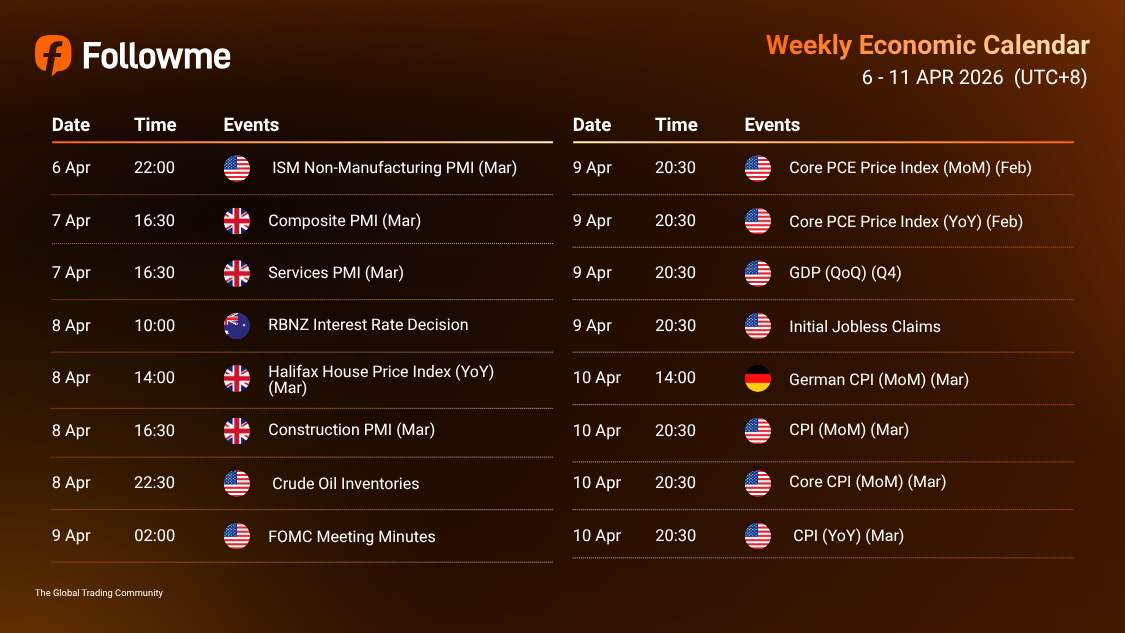
Weekly Economic Calendar: Week of 06 - 11 April, 2026 (GMT+8)
This week’s macro calendar begins with a service-sector and sentiment check before shifting into a more policy- and inflation-sensitive setup led by the United States. Monday opens with U.S. ISM Non-Manufacturing PMI, giving traders an early read on whether the largest part of the U.S. economy is still showing resilience. Tuesday then brings a UK-focused PMI block, while Wednesday adds a mix of RBNZ policy, UK housing and construction data, and U.S. crude inventories, creating a broader cross-market setup across USD, GBP, NZD, and commodity-linked sentiment.
The core market focus, however, builds into late Wednesday night and Thursday, when FOMC Meeting Minutes, Core PCE, U.S. GDP, Initial Jobless Claims, and then the full U.S. CPI cluster arrive in quick succession. This creates a high-impact window for repricing expectations around inflation, growth, Fed policy, and Treasury yields.
Europe also enters the picture on Friday through German CPI, which can influence EUR sentiment and broader inflation expectations across the region. Overall, this is a week where the market may begin with sector-specific and regional signals, but the main directional impulse is likely to come from the U.S. inflation-and-policy narrative into the second half of the week.
| Key highlights: |
🇬🇧 7 Apr, 16:30 – Composite PMI (Mar)
🇬🇧 7 Apr, 16:30 – Services PMI (Mar)
🇳🇿 8 Apr, 10:00 – RBNZ Interest Rate Decision
🇬🇧 8 Apr, 14:00 – Halifax House Price Index (YoY) (Mar)
🇬🇧 8 Apr, 16:30 – Construction PMI (Mar)
🇺🇸 8 Apr, 22:30 – Crude Oil Inventories
🇺🇸 9 Apr, 02:00 – FOMC Meeting Minutes
🇺🇸 9 Apr, 20:30 – Core PCE Price Index (MoM) (Feb)
🇺🇸 9 Apr, 20:30 – Core PCE Price Index (YoY) (Feb)
🇺🇸 9 Apr, 20:30 – GDP (QoQ) (Q4)
🇺🇸 9 Apr, 20:30 – Initial Jobless Claims
🇩🇪 10 Apr, 14:00 – German CPI (MoM) (Mar)
🇺🇸 10 Apr, 20:30 – CPI (MoM) (Mar)
🇺🇸 10 Apr, 20:30 – Core CPI (MoM) (Mar)
🇺🇸 10 Apr, 20:30 – CPI (YoY) (Mar)
🇺🇸 U.S. Services Signal on Monday
ISM Non-Manufacturing PMI is the first major release of the week and matters because the services sector represents the largest share of U.S. economic activity. A stronger reading can support the dollar by reinforcing the view that domestic demand and business activity remain firm. A weaker result may raise concerns that momentum is cooling earlier than expected.
🇬🇧 UK Services and Composite PMI on Tuesday
UK Composite PMI and Services PMI for March form the first key block for GBP this week. Since the UK economy is heavily driven by services, traders will watch whether activity remains in expansion territory. Firmer data can support the pound through improved growth expectations, while softer readings may increase concern over a weaker domestic outlook.
🇳🇿 RBNZ Policy Signal on Wednesday Morning
The RBNZ Interest Rate Decision is the main Asia-Pacific policy event of the week. Even if the rate itself is unchanged, traders will focus closely on the tone of the statement and any signals on inflation, domestic demand, and the future rate path. A firmer or less dovish message can support NZD, while a softer tone may pressure it.
🇬🇧 UK Housing and Construction Check on Wednesday
The Halifax House Price Index offers a read on the condition of the UK housing market, while Construction PMI helps show whether building activity is stabilizing or still under pressure. These are not always the biggest FX drivers on their own, but together they can shape sentiment around the broader UK growth backdrop.
🇺🇸 U.S. Energy and Policy Setup on Wednesday Night
Crude Oil Inventories matter through the inflation channel, since a large draw may support oil prices and keep inflation concerns elevated, while a large build may cool price pressure somewhat. Shortly after that, FOMC Meeting Minutes become important because traders will look for more detail on how Fed officials are thinking about inflation persistence, labour conditions, and the timing of future policy adjustments.
🇺🇸 Major U.S. Macro Cluster on Thursday
Core PCE Price Index, GDP (QoQ), and Initial Jobless Claims form the most important data cluster before Friday’s CPI release. Core PCE is especially important because it is one of the Fed’s preferred inflation gauges. GDP helps confirm whether growth remains solid, while Jobless Claims provide a fresh high-frequency look at labour-market conditions. Together, these releases can strongly influence how markets position ahead of CPI.
🇩🇪 Germany Inflation Signal on Friday Afternoon
German CPI (MoM) can affect EUR sentiment by shaping expectations around broader Eurozone inflation dynamics. A firmer print may support the euro by reducing room for a softer policy outlook, while a weaker number may encourage a more dovish interpretation.
🇺🇸 Main USD Inflation Window on Friday Night
The U.S. CPI (MoM), Core CPI (MoM), and CPI (YoY) releases are the core events of the week for USD traders. These numbers can quickly reset expectations for inflation, Fed policy, yields, and overall dollar direction. If CPI remains hot, the market may price in a more cautious Fed stance. If inflation softens meaningfully, traders may begin to price a less restrictive path ahead.
This is a second-half-heavy macro week, with the biggest pricing risk concentrated from late Wednesday through Friday. Early-week signals from U.S. services, UK PMI, and the RBNZ decision may shape initial positioning, but the broader market focus is likely to shift toward the dollar once FOMC Minutes, Core PCE, GDP, Jobless Claims, and the CPI block begin.
🟢 Bullish USD Scenario – Stronger Dollar Case
ISM Non-Manufacturing PMI comes in firm, showing U.S. services activity remains resilient.
Core PCE stays firm or exceeds expectations, keeping inflation pressure in focus.
U.S. CPI and Core CPI surprise to the upside, pushing yields and the dollar higher.
🔴 Bearish USD Scenario – Weaker Dollar Case
ISM Non-Manufacturing PMI softens, suggesting weaker service-sector momentum.
Core PCE cools, reducing concern around sticky inflation.
CPI and Core CPI come in below expectations, encouraging a less restrictive Fed interpretation.
🟡 Wild Cards – High Whipsaw Risk
FOMC Minutes may shift the dollar before the main inflation data even arrives.
A mixed set of U.S. data, such as soft GDP but firm Core PCE, could create choppy price action.
A hawkish RBNZ combined with hot U.S. inflation could create uneven moves across NZD pairs rather than a clean trend.
Check out full here: Followme Economic Calendar Tool
Follow Followme for the newest market updates




Tuyên bố miễn trừ trách nhiệm: Quan điểm được trình bày hoàn toàn là của tác giả và không đại diện cho quan điểm chính thức của Followme. Followme không chịu trách nhiệm về tính chính xác, đầy đủ hoặc độ tin cậy của thông tin được cung cấp và không chịu trách nhiệm cho bất kỳ hành động nào được thực hiện dựa trên nội dung, trừ khi được nêu rõ bằng văn bản.

Để lại tin nhắn của bạn ngay bây giờ