

By now, you know what prop firms promise (Lesson 1), the myths vs. realities (Lesson 2), and how prop firms actually make money (Lesson 3).
But here’s something most beginners miss:
Retail prop firms don’t exist in a vacuum.
They’re part of a larger ecosystem that includes technology providers, brokers, affiliates, regulators (or lack thereof), and, of course, the traders themselves.
Understanding this industry context is essential because it shows:
- Why so many prop firms popped up in recent years.
- Why some thrive while others collapse.
- Where the industry might be heading.
A Tale of Two Prop Worlds

As we discussed in Lesson 1, the term “prop firm” actually refers to two very different worlds:
1. Institutional Prop Firms (Traditional)
- Located inside banks, hedge funds, or trading firms.
- Traders are employees or contractors.
- Success is measured in long-term profits.
- High barriers to entry: degrees, track records, and interviews.
2. Retail Prop Firms (Modern Online Version)
- Accessible to anyone with a credit card and internet.
- Success is measured in challenge pass rates and payouts.
- Low barriers to entry: just sign up.
- Fueled by marketing and mass participation.
As a reminder, we’re focused on the retail prop firm ecosystem. But keeping the traditional world in mind helps you see how different today’s landscape really is.
Why Understanding the Ecosystem Helps You

If you’re a beginner, seeing the bigger picture prevents you from being naive:
- You’ll know why firms market so aggressively (they need constant new sign-ups).
- You’ll understand why tech providers back dozens of firms (they profit no matter what).
- You’ll realize why firms collapse (overpromising, undercapitalization).
- You’ll see your true role in the system (customer, not partner).
This perspective helps you make smarter choices about which firms to trust,
AND whether you even want to participate!
The Players in the Retail Prop Firm Ecosystem
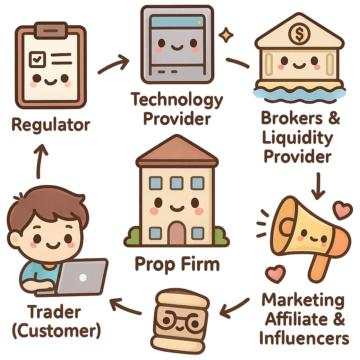
Here’s what most traders don’t realize: the prop firm you’re paying isn’t operating alone. There’s an entire industry built around your $100 evaluation fee.
Let’s pull back the curtain.
1. The Prop Firms (The Face of the Operation)
The companies selling challenges and (sometimes) paying out traders.
Ranges from small startups to large, established brands like FTMO, FundedNext, and Top One Trader.
But they’re just one piece of the puzzle.
2. Technology Providers (The Hidden Infrastructure)
Ever wonder how 50+ different prop firms all seem to have the same dashboards and challenge rules? That’s because companies like FPFX Tech and Axcera sell white-label platforms that power dozens of firms behind the scenes.
Think of it like WordPress or Shopify for prop firms. One company builds the back-end, and multiple “brands” slap their logo on it. Same infrastructure, different name.
These platforms handle everything: account creation, risk monitoring, trader dashboards, and payout processing. One provider can power 20+ firms simultaneously.
3. Brokers and Liquidity Providers (The Real Market Connection)
Some prop firms actually mirror your winning trades into real markets through broker partnerships.
Others? Pure simulation. You’re trading against a demo account the entire time, even after you’re “funded.”
The ones that do trade real capital use liquidity providers to access actual markets. The ones that don’t… well, that’s a topic for later.
4. Marketing Affiliates and Influencers (The Hype Machine)
This is where things get interesting.
Affiliate marketing has become the primary customer acquisition channel for retail prop firms.
The affiliate landscape centers on YouTube trading influencers, Instagram/TikTok micro-influencers, and Discord communities.
That YouTube trader showing off their “funded account” and Lambos? There’s a good chance they’re earning 8-25% commission on every challenge purchase made through their link.
Top affiliates make $10,000-$60,000+ per month. One documented case: $47,595 in 30 days from referrals alone.
Here’s the kicker: they earn commission every time you buy. You fail and reset? They get paid again. You try a different account size? Another commission.
This creates a massive incentive to hype up prop firms regardless of whether they’re actually good for you. The influencer wins either way.
5. Traders (You: The Fuel for Everything)
Traders pay an average of $4,270 in challenges over time. Many juggle multiple firms simultaneously, multiplying their risk and expenses.
Your fees don’t just pay for your challenge. They fund the entire ecosystem above. The tech providers, the affiliates, the marketing budgets, the sports car in the Instagram ad.
6. Regulators (Mostly Absent)
The unfortunate reality is that retail prop firms operate in a regulatory gray zone. Because they’re not “managing client funds” like a traditional broker, most avoid the scrutiny that comes with financial regulation.
Translation: minimal oversight, minimal accountability.
Why This Ecosystem Matters to You
When you understand who’s making money and how, you start to see the incentives clearly:
- The prop firm profits from evaluation fees, not your success.
- The tech provider doesn’t care who wins or loses. They get paid either way.
- The affiliate earns more when you fail and retry.
- The trader (you) is the only one taking real risk.
Everyone else gets paid upfront. You’re the only one gambling on a future payout.
That doesn’t mean you can’t win. But it does mean you need to go in knowing: you’re not joining a team. You’re entering a marketplace where everyone else has already been paid.
Why the Prop Firm Industry Exploded
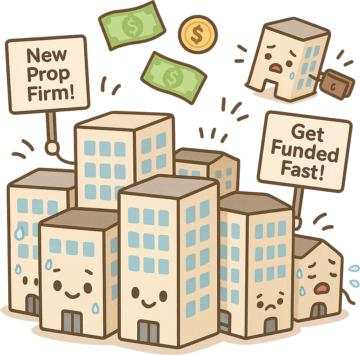
Five years ago, retail prop firms were a niche corner of the trading world. Today, they’re a multi-billion-dollar industry with millions of participants. What happened?
It wasn’t an accident. Several forces collided at exactly the right moment to create the perfect storm.
1. Anyone Can Launch a Prop Firm Now
Remember those white-label tech providers we talked about? They changed everything.
You don’t need a Wall Street pedigree or millions in capital anymore. You need $5,000, a revenue-share agreement with a tech provider, and decent marketing skills.
Within 1-7 days, you can have a fully operational prop firm with dashboards, payment systems, and risk monitoring.
Launch on Monday. Start collecting evaluation fees by Friday.
The barrier to entry collapsed, and hundreds of new firms flooded the market. Some legitimate, some… less so. We’ll get to that later.
2. The Pandemic Created an Army of New Traders
2020 changed everything:
- Stimulus checks landed in bank accounts
- People were stuck at home with time to kill
- Trading became the new side hustle, hyped endlessly on social media
Millions of people who’d never touched a stock suddenly thought they could day trade for a living. They needed capital. Prop firms promised exactly that.
3. Social Media Turned “Funded Trader” Into a Status Symbol
Scroll through Instagram or YouTube, and you’ll see it everywhere: screenshots of $10,000 payouts, Lamborghinis, beach setups with three monitors.
“I got funded in 3 days!”
“Just withdrew $8,500 from my prop account!”
These posts go viral. Affiliates share them. Trading communities celebrate them. And suddenly, being a “funded trader” isn’t just about making money. It’s about status, validation, proving you made it.
The hype became self-perpetuating. More success stories drove more sign-ups, which drove more affiliate commissions, which drove more marketing, which created more hype.
4. Prop Firms Felt Easier Than Traditional Brokers
Opening a real brokerage account means:
- Regulatory paperwork and verification.
- Minimum deposits (often $500-$2,000).
- Risk of losing your own money.
Prop firms offered a different pitch:
- Sign up in 5 minutes.
- Start with just $100-$500.
- “Trade with our capital, not yours!”
For beginners, the choice felt obvious. Why risk your own savings when you could “trade someone else’s money”?
Of course, we now know that’s not how it actually works. But the marketing was brilliant.
The Result?
An industry that barely existed in 2019 exploded into a global phenomenon. Thousands of firms. Millions of traders. Hundreds of millions in evaluation fees.
And almost no regulation watching any of it.
The broader B2B technology landscape includes major players such as: FPFX Tech, Axcera, Prop FinTech, YourPropFirm, Trade Tech Solutions, Centroid Solutions, FunderPro, PropGuru, and others.
The Business Model Ripple Effect
When an entire industry runs on the same business model (selling challenges with 90-95% failure rates), something interesting happens: the incentives ripple outward and shape the entire ecosystem.
Let’s trace how your evaluation fee creates effects far beyond just your account.
Tech Providers Print Money
Remember those white-label platforms? They don’t care if you pass or fail. They don’t care if the prop firm you’re trading with is legitimate or shady. They get paid either way.
One platform powers 20+ firms. Each firm brings thousands of traders. The tech provider collects their revenue share on every single evaluation fee, every single day.
They scaled massively because the model works for them no matter what happens to you.
Affiliates Optimize for Volume, Not Success
Here’s where the incentives get really twisted.
An affiliate earns 8-25% commission when you buy a challenge. They earn that same commission when you fail and buy another one. And another. And another.
So what’s their incentive? To help you succeed? No. To maximize the number of times you click “purchase.”
This is why you see so much flashy marketing: Fancy cars, beach setups, “$10K in 3 days!” success stories. The dream sells. The 90%+ failure rate? That part gets buried in fine print.
Since affiliates benefit from your failures (you buy more challenges), they’re financially motivated to keep you hopeful, not realistic.
The Trader Recycling Machine
Here’s the pattern that keeps the industry alive:
You fail at one firm. You try another. You fail there. You try a third. Meanwhile, you’re also attempting multiple challenge sizes at each firm.
Traders commonly move between firms after failures, creating a cross-pollination effect where the average trader engages with 2.2 prop firms simultaneously or sequentially.
Survey data shows 90% of traders interact with 2-5 different firms as they chase the elusive funded account.
This recycling pattern forms the economic backbone of the industry.
The typical journey involves 3 challenge attempts per account before traders either succeed or abandon the pursuit, with average spending reaching $4,270 before any profitability.
One documented testimonial describes burning through $7,000 over 7 failed challenges at roughly $1,000 per attempt.
With individual challenge fees ranging from $100-$1,000+, depending on account size, and traders attempting challenges across multiple firms, the aggregate spending becomes substantial while success remains elusive.
The economic model relies fundamentally on trader “recycling” where participants attempt an average of 3 challenges across 2-5 different firms, spending $4,270 before any success.
See the Pattern?
The entire ecosystem is optimized for one thing: keeping you in the game just long enough to pay multiple times.
Not long enough to actually win. Just long enough to believe the next attempt will be different.
The tech providers profit from scale. The affiliates profit from your retry attempts. The prop firms profit from evaluation fees. Everyone wins except the person actually taking the risk.
And because there’s minimal regulation, nobody’s incentivized to change it.
The Problem of Oversaturation
The boom led to overcrowding:
- Hundreds of new prop firms entered the market in a short span.
- Many were undercapitalized, relying purely on challenge fees to survive.
- The firms promised big payouts if the traders performed well.
Then the problems started…
- A lot of these new firms didn’t have much real money behind them.
- They depended mainly on the fees people paid to take trading “challenges” rather than making profits from actual trading.
- Many firms weren’t prepared for the risks: If a lot of traders passed the challenge and asked for payout, the firms had to pay out way more money than they took in from fees.
- Firms that didn’t have much real capital (money set aside to pay traders) couldn’t keep up with requests.
- As more traders passed these challenges and requested payouts, those weak firms couldn’t afford to pay everyone.
- Because payouts became too high, weaker firms collapsed.
The industry shrank as only the strongest, most reliable companies survived the mess.
This created what some call a “prop firm bear market,” which was a period where firms were forced to go out of business or merge due to unsustainable practices.
Lack of Regulation
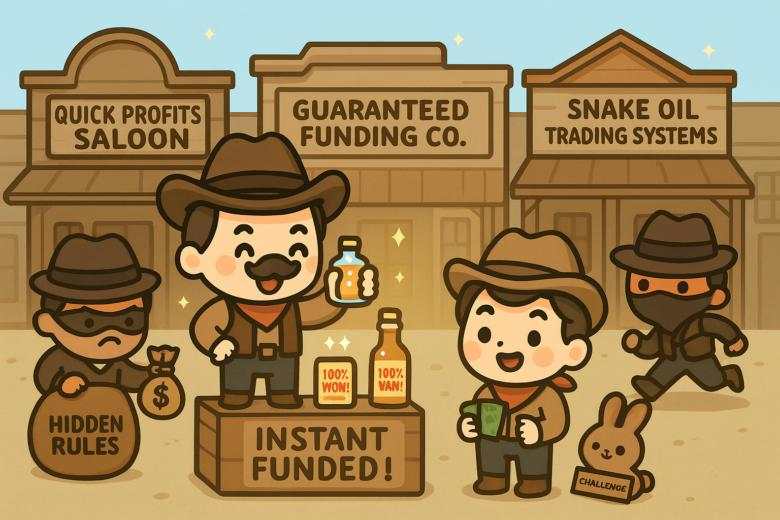
As mentioned earlier, the entire retail prop firm industry operates in a regulatory gray zone.
Traditional brokers? Heavily regulated. They need licenses, capital requirements, insurance, and audits. They have to follow strict rules about how they handle your money. If they screw up, there are consequences.
Retail prop firms? Almost none of that applies.
How Prop Firms Avoid Regulation
Prop firms have found a clever loophole. They argue:
“We’re not a broker. We don’t handle client funds. We only collect evaluation fees for a service (the challenge). And even when traders get ‘funded,’ they’re often trading on demo accounts, not real capital. So financial regulations don’t apply to us.”
It’s technically true. You’re not depositing money into a trading account. You’re buying a product (access to a challenge). That distinction keeps them out of the regulatory crosshairs.
No broker-dealer registration required. No capital adequacy standards. No consumer protection laws.
What This Means for You
When you pay a prop firm, you have:
- No guarantee they’ll pay you. Even if you pass the challenge and make profits, there’s no legal requirement for them to honor payouts. Some do. Some delay. Some disappear. 💨
- No protection if they shut down overnight. Firms have vanished, with thousands of traders’ evaluation fees. No regulatory body stepped in. No refunds. Just… gone. 👻
- No consistent standards. One firm might have reasonable rules. Another might have impossible conditions buried in the fine print. There’s no oversight ensuring fairness. 😈
The Wild West
This “Wild West” environment is part of why some traders thrive (fewer restrictions) but also why many get burned.
This lack of regulation cuts both ways.
For the rare trader who thrives, fewer restrictions mean more flexibility and faster payouts (when firms honor them).
But for the majority? It means operating in an environment where the rules are made up, enforcement doesn’t exist, and you’re entirely at the mercy of whether the firm decides to be ethical.
You’re not protected. You’re not insured. You’re gambling that the firm you chose is one of the good ones.
And there’s no way to know for sure until it’s too late.
Key Takeaways

- The retail prop firm industry is part of a larger ecosystem with firms, tech providers, brokers, affiliates, and traders.
- The boom was fueled by accessibility, social media hype, and low barriers to entry.
- Oversaturation has created instability, with many firms collapsing.
- The industry remains largely unregulated, creating both opportunities and risks.
- Understanding the ecosystem helps you see the incentives behind each player’s actions.
We’ve now zoomed out and explored the prop firm ecosystem.
You can see the bigger picture: firms, tech providers, traders, and affiliates all interacting in a wild, largely unregulated market.But now we arrive at the million-dollar question most beginners ask:
Are prop firms actually a scam?
In the next lesson, we’ll tackle this head-on, exploring why some firms deserve the label “scam,” while others operate more legitimately.


Để lại tin nhắn của bạn ngay bây giờ