

Markets extended their Thanksgiving week rally on Wednesday as growing Federal Reserve rate cut expectations and an unexpected hawkish tilt from the Reserve Bank of New Zealand overshadowed a chaotic UK budget rollout, sending equities and gold higher while the dollar weakened broadly.
Bitcoin stole the spotlight, surging nearly 4% to reclaim the $90,000 level as cryptocurrency traders positioned ahead of the US holiday, while UK assets navigated choppy waters following a premature budget leak that briefly rattled gilt markets before fiscal restraint measures ultimately provided relief.
Check out the forex news and economic updates you may have missed in the latest trading session!
Forex News Headlines & Data:
- Australia Construction Work Done for September 30, 2025: -0.7% q/q (0.1% q/q forecast; 3.0% q/q previous)
- Australia Consumer Price Index Growth Rate for October 2025: 0.0% m/m (0.4% m/m forecast; 1.3% m/m previous); 3.8% y/y (3.5% y/y forecast; 3.2% y/y previous)
- New Zealand RBNZ Interest Rate Decision for November 26, 2025: 2.25% (2.25% forecast; 2.5% previous)
- Japan Leading Indicators Index for September 2025: 108.6 (108.0 forecast; 107.0 previous)
- Swiss Economic Sentiment Index for November 2025: 12.2 (-8.8 forecast; -7.7 previous)
- ECB Financial Stability Review: euro area financial stability risks remain “elevated,” highlighting stretched asset valuations, especially around AI-related equities, and rising sovereign debt burdens as key vulnerabilities
- U.S. MBA 30-Year Mortgage Rate for November 21, 2025: 6.4% (6.37% previous)
- U.S. MBA Mortgage Applications for November 21, 2025: 0.2% (-5.2% previous)
- On Wednesday, Chancellor of the Exchequer Reeves announced £26B of tax increases in a budget that sought to balance the demands of both bond traders and Labour backbenchers.
- U.S. Durable Goods Orders for September 2025: 0.5% m/m (0.2% m/m forecast; 2.9% m/m previous)
- U.S. Initial Jobless Claims for November 22, 2025: 216.0k (224.0k forecast; 220.0k previous)
- U.S. Chicago PMI for November 2025: 36.3 (46.0 forecast; 43.8 previous)
- U.S. EIA Crude Oil Stocks Change for November 21, 2025: 2.77M (-3.43M previous)
- U.S. Fed Beige Book: described overall U.S. economic activity as little changed, with consumer spending softening, employment edging lower in roughly half of the districts, reinforcing market expectations for a December rate cut
Broad Market Price Action:
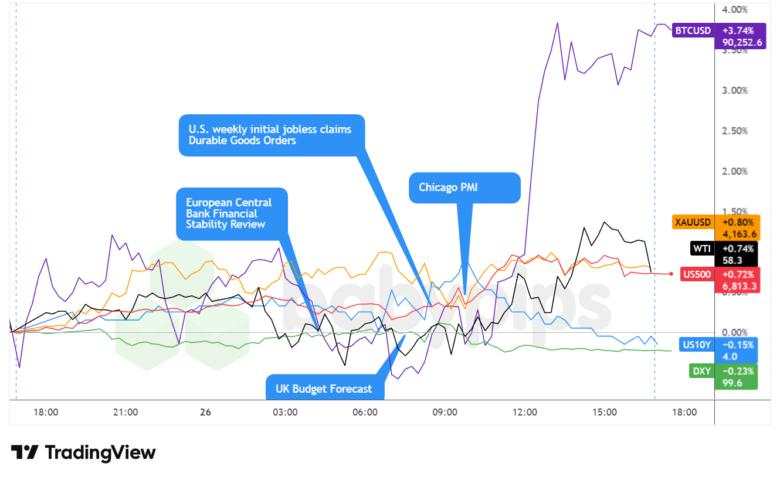
Dollar Index, Gold, S&P 500, Oil, U.S. 10-yr Yield, Bitcoin Overlay Chart by TradingView
Wednesday’s session delivered a sustained risk-on tone as traders positioned ahead of the US Thanksgiving holiday, with major asset classes posting broad gains despite mixed economic signals and a chaotic UK budget release.
The S&P 500 rallied steadily throughout the session, gaining 0.72% to close at 6,813.10 as technology shares led the advance. The index maintained upward momentum from the Asian open through the US afternoon, with the strongest surge occurring during mid-US trading hours around 2:00-3:00 pm ET, correlating with the Federal Reserve’s Beige Book release that reinforced December rate cut expectations by describing stagnant economic activity and weakening consumer spending.
Gold extended its record-breaking run, climbing 0.80% to settle around $4,163 per ounce. The precious metal posted gains throughout all three trading sessions, with particular strength during London hours possibly reflecting safe-haven demand amid the UK budget chaos and the ECB’s warning about elevated financial stability risks. Despite no direct gold-specific catalysts, the metal’s advance appeared supported by the combination of Fed rate cut expectations and ongoing fiscal sustainability concerns flagged by the ECB.
WTI crude oil managed modest gains of 0.74%, closing near $58.30, though the move lacked a clear directional catalyst. The unexpected 2.77M barrel build in US crude inventories typically would pressure prices lower, yet oil held gains throughout the session—suggesting broader risk appetite and positioning adjustments ahead of the holiday may have outweighed bearish inventory data.
Bitcoin dramatically outperformed all other major assets, surging 3.79% to break decisively above $90,000 and close at $90,288. The cryptocurrency’s explosive rally began during early London hours and accelerated through US trading, with the most pronounced move occurring around noon ET. There were no direct crypto-specific news to point to, so it’s possible that a combination of thin pre-holiday liquidity, short covering, and growing expectations that Kevin Hassett—seen as favorable to lower rates—could become the next Fed chair fueled the rally.
The 10-year Treasury yield declined modestly, falling about 6 basis points to settle around 4.00%. After leaning bullish early on, yields drifted lower throughout the U.S. session, with the most pronounced drop correlating with the afternoon Beige Book release that painted a picture of economic stagnation and reinforced December rate cut expectations. Despite stronger-than-expected initial jobless claims (216k versus 224k forecast), the broader narrative of Fed easing dominated bond market pricing.
FX Market Behavior: U.S. Dollar vs. Majors:
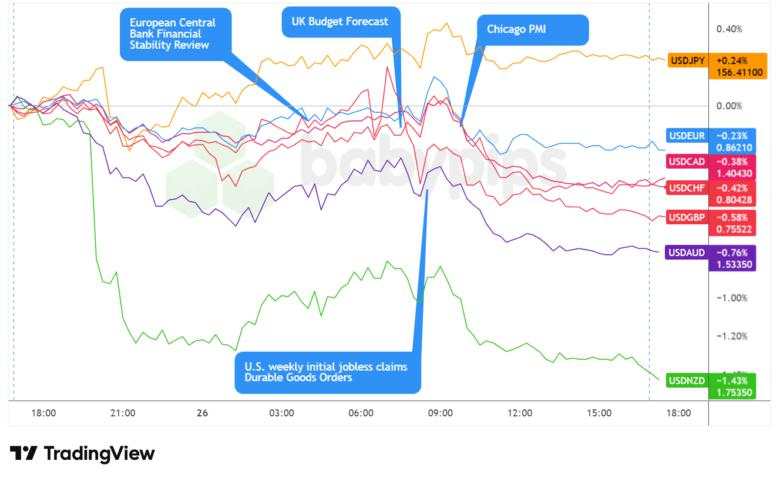
Overlay of USD vs. Majors Forex Chart by TradingView
The U.S. dollar suffered broad-based weakness on Wednesday, closing as the second-worst performing major currency with gains only against the Japanese yen, as growing Federal Reserve rate cut expectations and speculation about the next Fed chair likely dominated currency market dynamics.
During the Asian session, the dollar traded net lower against major currencies as Australia delivered a hotter-than-expected inflation print showing headline CPI rising 3.8% year-over-year versus the 3.5% forecast—the fastest pace in ten months. The data provided a solid lift to the Australian dollar, with AUD/USD rallying sharply from the Asian open as traders abandoned any near-term RBA rate cut expectations.
The New Zealand dollar also posted substantial gains after the RBNZ cut rates by 25 basis points to 2.25% as expected but shocked markets by signaling the easing cycle was effectively over, projecting the OCR to hold steady through early 2026 before rising. NZD/USD surged approximately 1% to one-week highs, with two-year swaps jumping on the hawkish guidance. The yen strengthened during Asian hours, likely on rising expectations of a near-term Bank of Japan rate hike following a Reuters report suggesting a possible December move.
The London session marked a slight reversal in dollar momentum, with the greenback posting net gains against major currencies during the morning European hours. The primary driver appeared to be chaotic UK budget developments—after the Office for Budget Responsibility accidentally released its fiscal forecasts an hour early, gilt yields initially spiked and sterling weakened on concerns about the fiscal trajectory. The dollar possibly benefited from this UK-centric volatility, with USD/GBP rising despite the fact that Chancellor Reeves’ budget ultimately revealed a larger-than-expected £22 billion fiscal buffer. The euro traded under pressure during London hours as the ECB’s Financial Stability Review highlighted elevated risks around stretched asset valuations and sovereign debt burdens, though these concerns seemed to be outweighed by relative dollar weakness later in the day.
At the US session open, the dollar attempted a brief bounce but quickly reversed course and traded net lower for the remainder of the session. The turning point came with the release of weaker-than-expected durable goods orders and, more significantly, the afternoon Fed Beige Book that described economic activity as “little changed” with consumer spending softening and employment declining in roughly half of the districts. This dovish assessment reinforced market expectations for a December rate cut, with traders now pricing in roughly 80% odds—up from less than 30% a week earlier.
The dollar’s broad weakness despite mixed US data underscores how rate cut expectations and Fed leadership speculation have become the dominant drivers of currency markets heading into the final weeks of 2025, with traders seemingly willing to look past any individual data point that doesn’t fit the easing narrative.
Upcoming Potential Catalysts on the Economic Calendar
- ANZ Business Confidence for November 2025 at 12:00 am GMT
- Australia Private & Building Capital Expenditure for September 30, 2025 at 12:30 am GMT
- Bank of Japan Noguchi Speech at 1:30 am GMT
- Germany GfK Consumer Confidence for December 2025 at 7:00 am GMT
- European Central Bank member Cipollone Speech at 8:30 am GMT
- Euro area Monetary Developments for October 2025 at 9:00 am GMT
- Euro area Consumer Confidence for November 2025 at 10:00 am GMT
- Euro area Economic Sentiment for November 2025 at 10:00 am GMT
- European Central Bank member Guindos Speech at 11:00 am GMT
- ECB Monetary Policy Meeting Accounts at 12:30 pm GMT
- Canada Current Account for September 30, 2025 at 1:30 pm GMT
- Canada Average Weekly Earnings for September 2025 at 1:30 pm GMT
- U.S. Markets Closed for Thanksgiving Day
Thursday’s calendar looks exceptionally light given the US Thanksgiving holiday, with American markets closed and liquidity expected to be thin across global markets. The most significant scheduled event will be Germany’s GfK Consumer Confidence reading, which could provide insight into whether German household sentiment is stabilizing after months of economic weakness. The eurozone’s monetary development data—including M3 money supply and lending to households and companies—will offer clues about credit conditions, while the bloc’s sentiment indicators could reveal whether business and consumer confidence is holding up amid ongoing growth challenges and elevated financial stability risks flagged by Wednesday’s ECB review.
ECB speakers Cipollone and Guindos may draw attention if they address the Financial Stability Review’s warnings about stretched valuations and sovereign debt vulnerabilities, particularly following the eurozone’s recent bond market volatility. The ECB’s Monetary Policy Meeting Accounts from the previous gathering could also shed light on internal discussions around the pace of future rate cuts.
In the absence of top-tier data, markets remain sensitive to any surprise news developments, particularly around US-China trade negotiations following President Trump’s comments about progress on a Ukraine peace deal, or any fresh commentary on Fed chair succession that could impact rate cut expectations. The combination of thin holiday liquidity and elevated positioning heading into month-end could amplify price reactions to any unexpected headlines, making Thursday’s session potentially volatile despite the quiet economic calendar.
Stay frosty out there, forex friends, and don’t forget to check out our Forex Correlation Calculator when planning to take on risk!

Để lại tin nhắn của bạn ngay bây giờ